Who is The Vampire Lestat?

Mati Rilasciati | July 2026
What does a vampire sound like? Well, “Nosferatu” from 1922 was mute, while the 2024 version of Count Orlok reminds us of a Romanian chain-smoker who skipped vocal warm-ups. Dracula has a whistling "S," or, in “Hotel Transylvania”, Adam Sandler’s playful voice. Edward Cullen and the Salvatore brothers add a seductive note to a vampire’s speech, but the question lingers, as we can’t truly pinpoint a specific sound to a vampiresque identity. But if you think that this would prevent Monsieur de Lioncourt from belting out tunes left and right, you are fundamentally wrong.
Now, let’s take a step back and rewind 50 years: Anne Rice’s “Interview with the Vampire” had just hit the shelves in the US. The novel achieved reasonable success, but its characters truly reached notoriety almost 20 years later when Neil Jordan adapted the story for the big screen. In the role of Louis de Pointe du Lac, we see a long- and dark-haired, innocent-looking Brad Pitt, and as Lestat de Lioncourt, we have a captivating and menacing blond Tom Cruise. Both in their early thirties at the peak of their careers, the actors were the first, but not the last, to embody the two protagonists of Anne Rice’s tale.
The plot of the story revolves around Louis, who tells his personal story in a then-present-day interview, and through his memories, we discover how and when he became a vampire, alongside Lestat’s role of maker, lover (their carnal relationship ultimately left implied in the film adaptation), and co-parent. Both men – or, better said, former men – have a complicated relationship with attachment, immortality, codependency, and their own vampiric nature.
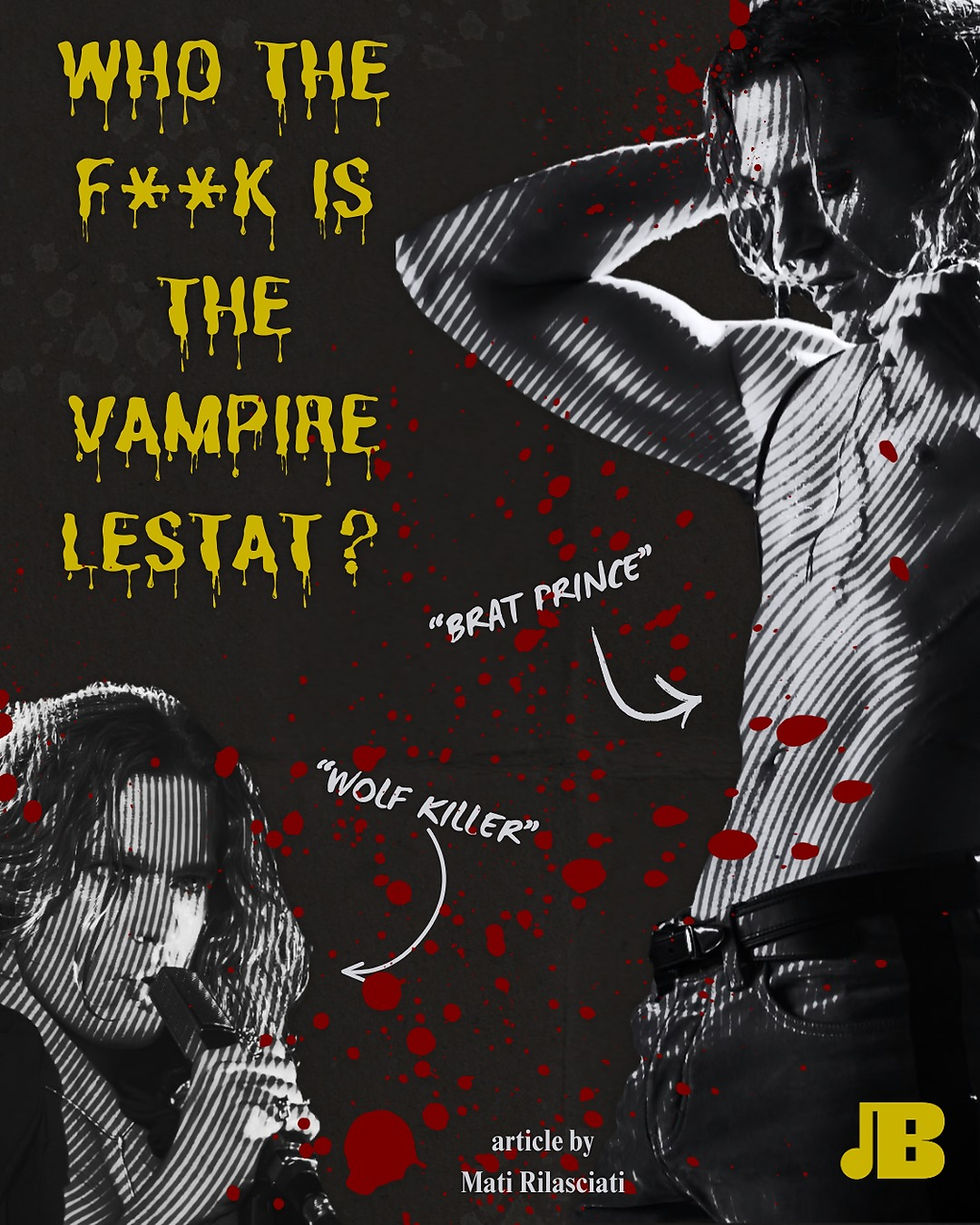
The co-leading character of Lestat, whose bursts of anger and manipulative tendencies lead him to an apparently eternal state of unhappiness, brings forward a new image of a vampire: flawed and reckless, broken despite being basically impossible to kill. Lestat ‘the Brat Prince’ de Lioncourt is further developed by Anne Rice in “The Vampire Chronicles” book series, where we witness his ascent to success as a modern-day rock star.
An attempt to musically capture the essence of the Vampire Lestat took place in 2002 with the film “Queen of the Damned”, where Lestat’s singing voice belonged to none other than metal band Korn’s Jonathan Davis, who is also credited as a co-writer of the five Lestat songs on the soundtrack. The film, however, failed to captivate audiences, and for the following two decades, no one revisited the character on screen.
This leads us to 2022, when AMC announced their production of a TV show based on Anne Rice’s novels. Expectations rose as more details emerged, such as the casting of the leads – British actor and musician Jacob Anderson plays Louis, who is now a Creole man of color, whereas the role of Lestat belongs to Australian actor Sam Reid.
The show nails what the film did not manage to, and it does so brilliantly by not shying away from conversations about race, religion, and sexuality while delivering a powerful tale about characters on the cusp between humanity and monstrosity. Anne Rice unfortunately passed away following a stroke before the production had wrapped up and never got a chance to see this brand-new version of her beautifully written characters.
AMC’s “Interview with the Vampire” was renewed for a second season, which premiered in 2024 and followed the timeline of Louis’ story up until the present day: introducing new locations, new characters, and more doubt regarding Louis’ reliability when it comes to storytelling. Out of the Interview, a book is finally published in 2025 within the show’s universe, and that’s the cue for Lestat to pick up the mic and set the record straight. Today, the Brat Prince is the main character of his own show (the third season is titled “The Vampire Lestat”), and he is nothing like we have seen of him before: once a French aristocrat haunting 20th-century New Orleans, he’s now a flashy, camp, and outrageously provocative rock star on tour with his band. A far cry from his ex’s interview tapes, Lestat’s music and voice recordings are messy, impulsive, and non-linear.
Composed by Daniel Hart (who scores all seasons of the show), Lestat’s music is performed by Sam Reid, who took singing, piano, and even violin lessons in preparation for his on-screen stage debut. Genres like glam rock, classical music, and modern pop all contributed to Lestat’s sound, and artists like T. Rex, David Bowie, The Rolling Stones, and Iggy Pop have been credited by the showrunners as inspiration for the character’s discography. In honor of the new season premiere on June 2, a one-night-only live concert was held at the Beacon Theatre in New York, where fans had the chance to witness a real-life performance of their beloved flamboyant vampire.
Let’s now dig deeper into this season’s tunes and take a look into a masterfully crafted soundtrack that redefines a character, his past, and the audience’s perception of him.
Track 1: "Long Face"
Published on YouTube this February, “Long Face” is the first track of Lestat's that we have the pleasure of listening to. Audacious and poignant, suggestive and upfront, the lyrics immediately evoke a vivid image of the artist, who strikes as disinhibited, highly sexual, and sarcastic, both in tone and words.
He frequently hints at vampirism in a playful way, although his true vampiric nature remains unveiled to the audience within the TV show – his persona on display is that of a human pretending to be a vampire and not vice-versa. The first verse features the lines “Why the long face? / My pretty baby / I've got long fangs / Come appraise me / Bring your long stakes / That doesn’t phase me”, which perfectly capture the essence of this narcissistic yet intriguing century-old rock star.
In “Long Face”, rhythm and vocals come together gorgeously, riding the soundwaves of typical late-'80s rock electric guitars.
Track 2: "All Fall Down"
The title sequence song, “All Fall Down”, might be just a minute long, but its energy will immediately send a buzz through your veins as soon as you hit play.
The track is catchy and loud, and serves as a first-person introduction of Lestat, who tells us exactly who he is as an individual: “I'm the chill creepin’ up your spine / Tellin’ you to run” and as the frontman of a band: “We’re the good time / We’re the heart pumping blood”. Guitar riffs and heavy drums lure you into the chaotic world of immortal creatures in the TV show, and they do so in a peculiarly “Bang, bang / Bang, bang”-ing fashion.
Track 3: "Butterscotch Bitch"
The Brat Prince does not hold back in this song: he’s kinky, entitled, and unapologetically arrogant. If you were still doubtful about the actual level of messed-up that you were about to encounter, “Butterscotch Bitch” clears the air.
The filler lyrics (a Lestat trademark) make the chorus infectious and impossible to get out of your head, with its cadenced drums and dramatic crescendos. References to vampirism and witchcraft bloom left and right, such as in “Hang every rope / Burn every witch”, but they serve as a tool to highlight how untouchable the singer is despite being “A crumpled crooner past his power”.
Track 4: "Your Biggest Fan"
Things take an unexpected turn with “Your Biggest Fan”; in which acoustic guitars replace decisive basslines, and a previously unheard gentle voice comes through like a beacon of light in the darkness.
This track, unlike the others, is not immediate and straightforward, and it requires some background knowledge regarding Lestat’s past – more specifically, the circumstances under which he became a vampire. The lyrics are all from Lestat’s maker's point of view; therefore, the artist is singing about himself on the receiving end of obsessive praise “I need you to need me”.
This bond comes across as toxic straight away, and we’ve barely scratched the surface – what is mentioned in the song is just the tip of the iceberg of the abuse, both physical and psychological, that Lestat had to endure at the hands of his maker. Musically, the song progresses into a complex instrumental soundscape, heightened by the growing momentum of the vocals, which shift into a more desperate rather than praising tone.
You can watch “The Vampire Lestat” on AMC and AMC+ from June 7, with new episodes (and songs) every Sunday, and you can listen to the vampire Lestat’s music on all streaming platforms.
Click here for “The Vampire Lestat” official playlist!